
Introduction
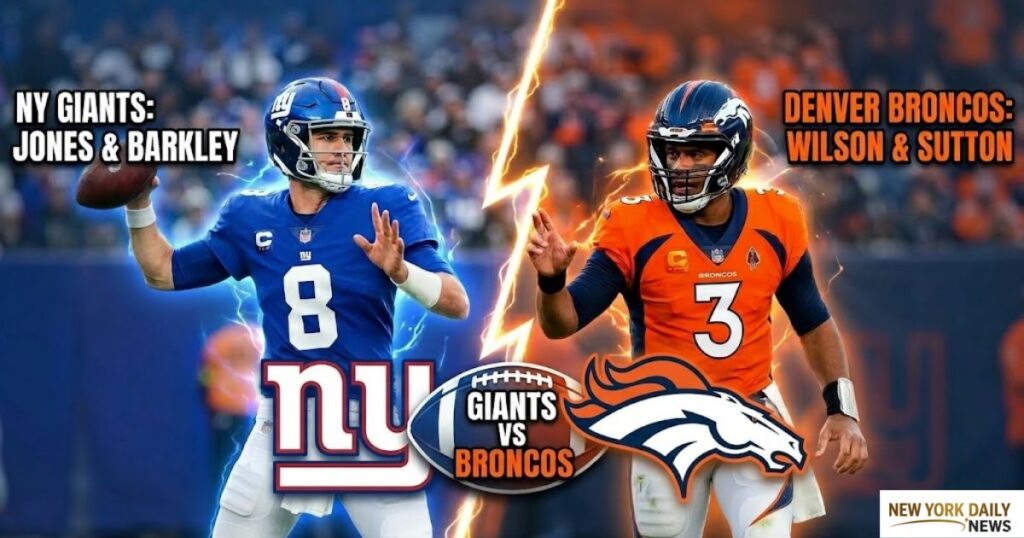
The rivalry between New York and Denver has always produced competitive football, but few meetings captured the sheer unpredictability of their Week 7 encounter in the 2025 season. As both teams took the field, the narrative was centered on the evolution of their respective offenses and the emergence of young talent under center. This specific matchup proved to be a statistical goldmine for analysts, featuring a high-scoring fourth-quarter explosion that completely shifted the momentum of the game. Fans looking for new york giants vs denver broncos match player stats will find that this contest was defined by career-high performances and a dramatic comeback that saw 33 points scored by the home team in the final period alone.
The game served as a benchmark for both franchises as they navigated the complexities of a mid-season push. For New York, the focus was on establishing a rhythmic passing attack, while Denver relied on the poise of their rookie signal-caller to orchestrate a late-game surge. Understanding the data behind these plays provides a clearer picture of how a 19-point lead can evaporate in the thin air of the Mile High City. In the following sections, we break down the specific contributions of the quarterbacks, the ground game, and the defensive units that shaped the final 33-32 outcome.
Quarterback Performance and Passing Efficiency
The aerial duel was the centerpiece of the afternoon, featuring two quarterbacks who attacked the secondary with contrasting styles. For the visiting team, Jaxson Dart delivered a performance that highlighted his growing chemistry with his tight ends and perimeter threats. Dart finished the day with 283 passing yards on 15 completions, showcasing an aggressive “big play” mentality. His efficiency was reflected in a staggering 8.1 yards per pass attempt, a figure that kept the defense on its heels for the first three quarters. Dart’s ability to find open windows in the middle of the field allowed New York to build a seemingly insurmountable lead, ending his day with three passing touchdowns and one rushing score.
On the opposing sideline, Bo Nix demonstrated why the local faithful have remained patient with his development. While his completion percentage was lower than his season average, his volume was immense. Nix attempted 50 passes, a career-high for the young quarterback, completing 27 of them for 279 yards. More importantly, he protected the football, throwing zero interceptions despite the constant pressure from a relentless pass rush. Nix’s contribution extended beyond his arm; his two rushing touchdowns in the fourth quarter were the catalysts for the comeback. His poise under pressure and ability to extend plays with his legs ultimately proved to be the difference-maker in the final minutes.
Impact of the Ground Game on Momentum
Rushing metrics often dictate the physical tone of a football game, and this matchup was no exception. Denver leaned heavily on the veteran presence of J.K. Dobbins to keep the chains moving. Dobbins managed 81 yards on 14 carries, averaging an impressive 5.8 yards per attempt. His ability to break tackles and gain yards after contact forced the opposing linebackers to play closer to the line of scrimmage, which eventually opened up passing lanes for the wide receivers. The rushing attack was supplemented by Nix’s mobility, as he added 48 yards on the ground, consistently punishing the defense when they vacated the pocket to pursue downfield targets.
The visiting team’s rushing strategy focused on a committee approach led by Cam Skattebo and Tyrone Tracy Jr. Skattebo was the primary workhorse, tallying 60 yards on 16 carries. While he didn’t find the end zone on the ground, his presence was vital in maintaining a balanced offensive profile. Tyrone Tracy Jr. provided the highlight of the rushing unit with a 31-yard touchdown run, which at the time appeared to be the dagger that would seal the victory. Despite averaging 3.7 yards per rush as a team, the New York backfield successfully controlled the clock for over 30 minutes, though they struggled to find the same level of production during the critical fourth-quarter defensive stand by Denver.
Receiving Corps and Vertical Threats
The passing game’s success was largely dependent on the play of the receiving units, which featured several standout individual efforts. Wan’Dale Robinson was a frequent target for New York, hauled in six receptions for 95 yards. His role as a reliable chain-mover was complemented by the explosive playmaking of Daniel Bellinger. Bellinger only recorded three catches, but they accounted for 88 yards, including a career-long 44-yard touchdown reception that opened the scoring. This verticality was further supported by Theo Johnson, who added a 41-yard touchdown of his own, demonstrating the versatility of the team’s tight end room in the red zone and beyond.
Denver’s receiving efforts were led by the reliable Courtland Sutton, who continues to climb the franchise’s all-time record books. Sutton caught six passes for 87 yards, consistently winning 50/50 balls and providing a safety valve for Nix. Marvin Mims Jr. also had a significant impact, matching Sutton with six receptions for 85 yards. In the clutch moments of the fourth quarter, Troy Franklin emerged as a key target, catching a 2-yard touchdown pass and a crucial two-point conversion that narrowed the scoring gap. The ability of the Denver receivers to stay disciplined during the scramble drills allowed Nix to find open targets as the pocket collapsed during the late-game comeback.
Defensive Contributions and Turnovers
While the scoreboard suggested an offensive clinic, the defensive units played a massive role in the game’s final trajectory. The New York pass rush, led by Abdul Carter and Brian Burns, was a constant nuisance for the Denver offensive line. Carter was particularly disruptive, recording multiple hits on the quarterback and helping to force several stalled drives in the first half. The secondary, anchored by Tyler Nubin and Bobby Okereke, largely held the Denver passing game in check for 45 minutes, allowing only minimal gains on third downs. However, the exhaustion of the defensive unit became apparent in the fourth quarter when Denver’s fast-paced offense began to exploit fatigue.
Denver’s defense, though shredded early in the game, made the plays that mattered most when the game was on the line. They managed to secure the game’s only turnover, an interception that shifted the field position and momentum in favor of the home team. By tightening their coverage in the red zone during the final quarter, they forced New York into difficult fourth-down situations. The defensive line also stepped up during the final drive, ensuring that Jaxson Dart did not have a clean pocket to work with as he attempted to lead a game-winning drive. This bend-but-don’t-break mentality allowed the offense enough opportunities to reclaim the lead.
Special Teams and the Final Margin
In a game decided by a single point, the efficiency of special teams often becomes the deciding factor. Denver’s Wil Lutz was the ultimate hero of the afternoon. While he was perfect on his extra-point attempts, his most significant contribution came as time expired. Lutz drilled a 39-yard field goal through the uprights to secure the 33-32 victory, capping off an incredible team effort. His consistency throughout the season has been a cornerstone for the team, and his ability to remain calm under the immense pressure of a game-winning kick further solidified his value to the roster.
Conversely, the visiting team struggled with the administrative aspects of the kicking game. Jude McAtamney had a difficult afternoon, missing two critical extra-point attempts. In a one-point loss, these missed opportunities were glaring. Had either of those kicks been successful, the final drive of the game would have carried a completely different set of stakes. While the punting unit performed admirably, pinning Denver deep in their own territory several times, the lack of precision in the place-kicking department ultimately left the door open for Denver’s late-game heroics. These small margins are what define NFL outcomes and provide deep context for new york giants vs denver broncos match player stats.
Historical Context and Head to Head Trends
The 2025 meeting added another chapter to a series that has historically been quite balanced. Entering this game, the Giants held a slight disadvantage in the all-time series, and the loss brought their record against Denver to 6-8. Historically, these matchups have been characterized by close scores, including a 24-23 victory for New York in 2005 and a 20-16 win in 1998. The most famous encounter remains Super Bowl XXI, where New York emerged victorious. However, in recent years, Denver has had the upper hand, winning four of the last five meetings dating back to 2009.
This specific game also highlighted the shift in offensive philosophies between the two franchises. In past decades, these teams relied on dominant defensive lines and a conservative “ground and pound” style. Today, the new york giants vs denver broncos match player stats reflect a move toward high-volume passing and mobile quarterbacks. The 2025 matchup saw a combined 794 yards of total offense, a far cry from the defensive struggles of the late 80s and early 90s. As both teams continue to rebuild around young talent, this rivalry is likely to continue producing high-scoring affairs that challenge the record books of both storied organizations.
Season Implications and Future Outlook
The result of this Week 7 clash had immediate and long-lasting effects on the 2025 standings. For Denver, the win moved them to 5-2 and kept them in the hunt for the AFC West crown. It served as a proof of concept for their rookie quarterback and boosted the team’s confidence in close-game scenarios. This victory would eventually propel them toward a strong 14-3 finish to the regular season. The resiliency shown in the fourth quarter became a trademark of their campaign, proving that they were never out of a game regardless of the deficit.
For New York, the loss was a bitter pill to swallow, dropping them to 2-5 at the time. It exposed vulnerabilities in the special teams unit and raised questions about the defense’s ability to close out games. Despite the loss, the performance of Jaxson Dart provided hope that the franchise had finally found its long-term answer at quarterback. The offensive explosion during the first three quarters showed that the team possessed the personnel to compete with the elite teams in the league. As they moved forward into the latter half of the 2025 season, the lessons learned from this narrow defeat in Denver were instrumental in their late-season development.
Player Statistics Overview
| Player | Team | Pass Yds | Pass TD | Rush Yds | Rush TD | Rec Yds | Rec TD |
| Bo Nix | DEN | 279 | 2 | 48 | 2 | 0 | 0 |
| Jaxson Dart | NYG | 283 | 3 | 11 | 1 | 0 | 0 |
| J.K. Dobbins | DEN | 0 | 0 | 81 | 0 | -1 | 0 |
| Cam Skattebo | NYG | 0 | 0 | 60 | 0 | 34 | 1 |
| Courtland Sutton | DEN | 0 | 0 | 0 | 0 | 87 | 0 |
| Wan’Dale Robinson | NYG | 0 | 0 | 0 | 0 | 95 | 0 |
| Daniel Bellinger | NYG | 0 | 0 | 0 | 0 | 88 | 1 |
| Marvin Mims Jr. | DEN | 0 | 0 | 13 | 0 | 85 | 0 |
FAQs
Who was the leading passer in the game?
Jaxson Dart led all passers with 283 yards, though Bo Nix accounted for more total touchdowns when including his rushing scores.
How many rushing touchdowns did Bo Nix have?
Bo Nix recorded two rushing touchdowns, both of which were pivotal in Denver’s fourth-quarter comeback.
What was the final score of the 2025 match?
The Denver Broncos defeated the New York Giants with a final score of 33-32.
Which receiver had the most yards for New York?
Wan’Dale Robinson led the New York receiving corps with 95 yards on six receptions.
Who kicked the game-winning field goal?
Wil Lutz kicked a 39-yard field goal as time expired to secure the win for Denver.
Conclusion
The 2025 showdown between these two teams will be remembered as one of the most thrilling games of the season. The new york giants vs denver broncos match player stats tell the story of a game with two distinct halves: one dominated by the clinical passing of Jaxson Dart and another defined by the sheer will and rushing ability of Bo Nix. While the visitors showcased an explosive offense and a formidable pass rush, the inability to execute on special teams and sustain defensive pressure in the final period proved costly. Denver’s 33-point fourth-quarter outburst stands as a testament to their offensive potential and late-game poise.
For fans and analysts, the data from this game provides a wealth of information regarding player development and team identity. The high yards-per-attempt figures for the passing game and the efficiency of the primary running backs highlight two offenses that are trending in the right direction. As the 2025 season progressed, both teams utilized the tape from this matchup to refine their strategies. Whether it was Denver building on their comeback momentum or New York addressing their kicking woes, this specific meeting was a pivotal moment in the NFL calendar that will be discussed for years to come.