
The expansion of the Leagues Cup has birthed several cross-border rivalries, but few have captured the imagination like the matches between Major League Soccer’s Inter Miami CF and Liga MX’s Tigres UANL. The inter miami vs tigres uanl timeline represents a clash of philosophies: the star-studded, attacking flair of South Florida against the disciplined, tactical grit of one of Mexico’s most successful modern clubs. Since their first encounter in 2024, these two sides have consistently delivered high-drama football that highlights the closing gap between the two leagues.
For fans and analysts, tracking this timeline is essential to understanding the evolution of both squads. While Inter Miami has leaned heavily on its veteran leadership and global icons to navigate knockout tournaments, Tigres has relied on its “Old Guard” and collective chemistry to spoil the party. As of early 2026, the head-to-head record remains perfectly balanced, with each side claiming a 2-1 victory in continental competition. This equality has turned every subsequent rumor of a friendly or competitive fixture into a must-watch event for North American soccer enthusiasts.
The Inaugural Clash in Houston 2024
The first significant chapter in this history was written on August 3, 2024, at NRG Stadium in Houston. Serving as the final group stage fixture of the Leagues Cup, the match carried immense weight for seeding. Tigres UANL struck first in the 18th minute through Juan Brunetta, whose clinical finishing silenced the pro-Miami crowd. Inter Miami struggled to find their rhythm in the first half, missing the creative spark often provided by their sidelined stars, yet they remained resilient under the lights in Texas.
The second half saw a spirited comeback attempt led by Leonardo Campana. In the 74th minute, Campana converted a penalty to level the score, a goal that also saw him tie Gonzalo Higuaín as the club’s all-time leading scorer at the time. However, the experience of the Mexican side proved decisive. Juan Pablo Vigón found the back of the net in the 84th minute after a set-piece scramble, securing a 2-1 win for Tigres. This result ensured Tigres topped Group East 3 and served as a wake-up call for the Herons.
Tactical Evolutions for the 2025 Quarterfinal
By the time the two teams met again in August 2025, the stakes had escalated to a knockout environment. The Leagues Cup Quarterfinal at Chase Stadium featured a more tactically mature Inter Miami side under the guidance of Javier Mascherano. Miami opted for a 4-2-3-1 formation designed to crowd the midfield and neutralize Tigres’ playmakers. This shift was a direct response to the space they had afforded Juan Brunetta in their previous encounter, showing a clear growth in the coaching staff’s preparation.
Tigres, meanwhile, maintained their traditional 4-4-2 shape, emphasizing wide play and crossing. The tactical battle in the first 45 minutes was a stalemate, with both midfields cancelling each other out. However, Miami’s high-press strategy began to pay dividends as they forced Tigres into uncharacteristic errors near their own penalty area. This evolutionary step—moving from a possession-based side to a high-energy pressing unit—was the defining theme of the 2025 matchup and provided the foundation for their eventual progression.
Luis Suarez and the Penalty Drama
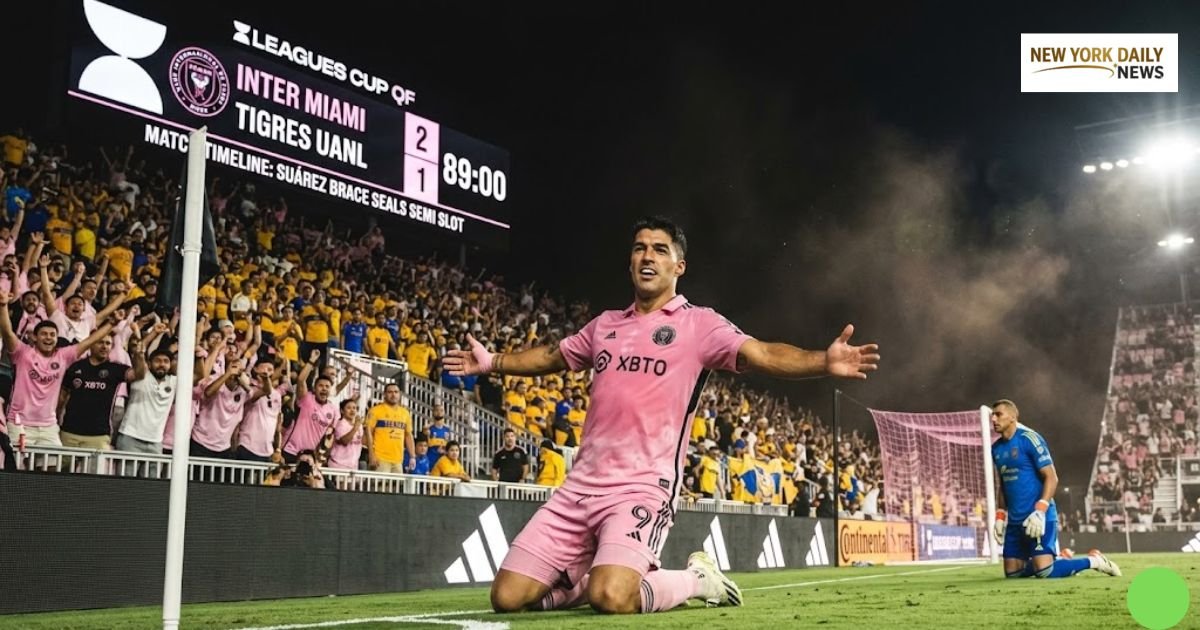
The 2025 quarterfinal will forever be remembered as the “Luis Suárez Show.” With Lionel Messi sidelined due to a muscle concern, the Uruguayan veteran took full responsibility for the team’s offensive output. In the 23rd minute, Suárez opened the scoring from the penalty spot after a handball by Javier Aquino. The legendary striker showed no nerves, slotting the ball home to give the home side an early advantage. His leadership on the pitch was palpable, constantly barking orders and organizing the young Miami attackers.
The drama reached its peak in the final minutes of the match. After Tigres had equalized through Ángel Correa in the 67th minute, the game seemed destined for a penalty shootout. However, in the 89th minute, another handball in the box—again involving Aquino—gave Miami a lifeline. Suárez stepped up once more, converting his second penalty of the night to secure a 2-1 victory. This brace not only sent Miami to the semifinals but solidified Suárez’s legacy as a big-game player for the Florida outfit.
Key Player Performances and Match Ratings
Analyzing the individual performances in these matches reveals why the rivalry is so closely contested. In the 2025 victory, Yannick Bright was a standout performer in the defensive midfield for Miami, earning high ratings for his ability to break up Tigres’ counter-attacks. His partnership with Sergio Busquets provided the “steel and silk” necessary to survive the technical onslaught of the Liga MX side. On the defensive line, Ian Fray received praise for his recovery speed and aerial dominance against the physical Nicolás Ibáñez.
For Tigres, Juan Brunetta remained their most consistent threat across the timeline. Even in defeat, his vision and passing range caused Miami significant problems. In the 2025 match, Ángel Correa proved why he was a top-tier acquisition for the Mexican club, scoring a brilliant equalizer and nearly adding a second if not for a spectacular save by Óscar Ustari. The ratings across these matches suggest that while Miami has more “star power,” Tigres possesses a more balanced squad where any player can change the game.
The Atmosphere at Chase Stadium
Chase Stadium has become a fortress for Inter Miami, and the 2025 quarterfinal provided one of the most electric atmospheres in the venue’s history. With an attendance of over 18,500, the energy was a mix of South American passion and North American spectacle. The proximity of the fans to the pitch at the Fort Lauderdale site creates an intimidating environment for visiting teams, particularly during the humid August nights that characterize the Leagues Cup schedule.
Tigres fans traveled in significant numbers, creating a vocal “away wall” that rivaled the home supporters. This cultural collision is exactly what tournament organizers envisioned when merging the two leagues. The constant chanting and the sea of yellow and pink jerseys highlighted the growing significance of this matchup. For the players, the intensity of the crowd often translated into a more physical game, with the 2025 match seeing several yellow cards as tensions boiled over in the Florida heat.
Injury Impacts and Roster Changes
The timeline of these matches has often been shaped by who was not on the pitch. In 2024, Miami was still integrating several key pieces, while the 2025 quarterfinal was defined by the absence of Lionel Messi. Messi’s fitness was a major talking point leading up to the August 20 meeting, with Javier Mascherano eventually deciding not to risk the captain. This absence forced Miami to find a different way to win, relying on defensive organization rather than individual magic.
Tigres also faced their share of roster challenges. The aging core of the team, including legends like André-Pierre Gignac, meant that the coaching staff had to be strategic with minutes. In the 2025 match, Gignac was used as a late substitute, a move that nearly paid off when a late header struck the woodwork. These roster dynamics show how both clubs are managing the transition between their established veterans and a younger generation of talent as they prepare for the 2026 domestic seasons.
Looking Ahead to Future Encounters
As we look toward the remainder of 2026, the prospect of a third competitive meeting is high. Both teams have established themselves as perennial contenders in their respective leagues and in continental play. The lessons learned from the first two matches—Tigres’ victory in 2024 and Miami’s revenge in 2025—will undoubtedly influence the next tactical setup. Coaches in both leagues now use these matches as blueprints for how to handle cross-border opposition.
The growth of this rivalry is a positive sign for the sport in North America. It proves that the Leagues Cup format can produce meaningful, high-stakes narratives that resonate with fans in both the US and Mexico. Whether the next chapter is written in the CONCACAF Champions Cup or another Leagues Cup edition, the history between these two clubs suggests it will be settled by the narrowest of margins. The balance of power remains in flux, making every second of their shared timeline essential viewing.
Head-to-Head Match History
| Date | Competition | Venue | Winner | Score | Key Scorer(s) |
| August 4, 2024 | Leagues Cup (Group) | NRG Stadium | Tigres UANL | 2 – 1 | Brunetta, Vigón (TIG) |
| August 20, 2025 | Leagues Cup (QF) | Chase Stadium | Inter Miami | 2 – 1 | Luis Suárez (MIA) |
| Total Record | 2 Matches | N/A | Tie | 3 – 3 | Luis Suárez (2) |
Frequently Asked Questions
Who has won more matches between Inter Miami and Tigres?
As of March 2026, the series is tied. Tigres won the first meeting 2-1 in 2024, and Inter Miami won the second meeting 2-1 in 2025.
Did Lionel Messi play in the 2025 quarterfinal against Tigres?
No, Lionel Messi missed the 2025 Leagues Cup quarterfinal due to a muscle injury. Luis Suárez led the team in his absence, scoring both goals in a -1 victory.
Where was the first Inter Miami vs Tigres match played?
The first match took place on August 4, 2024, at NRG Stadium in Houston, Texas, during the group stage of the Leagues Cup.
Who is the top scorer in this specific rivalry?
Luis Suárez is the top scorer with 2 goals, both coming from the penalty spot during the 2025 quarterfinal win for Inter Miami.
Conclusion
The inter miami vs tigres uanl timeline is a compelling story of two clubs fighting for regional supremacy. From the group stages in Texas to the high-stakes knockouts in Florida, each match has added a layer of tactical intrigue and individual heroism. As the 2026 season progresses, the memory of these battles continues to fuel the competitive fire between MLS and Liga MX. For the fans, this rivalry is a reminder that in North American soccer, the most dramatic stories are often those that cross borders.